
Vulcan to the Sky” XH558 was a 27 Squadron SECRET “SNIFFER


INTRODUCTION

Avro Vulcan XH558 “The Spirit of Great Britain” is undoubtedly the most famous V Bomber. It first flew in 1960 and was the last remaining Vulcan to fly, with its final flight being on the 28th October 2015 at Doncaster Airport (previously RAF Finningley) where it remains today under the custodianship of “The Vulcan to the Sky Trust”, a charity committed to its preservation.
On the “Vulcan to the Sky” website, currently there is scant detail on XH558’s role from 1961 to 1984, simply stating that the aircraft served as a strategic bomber during the height of the Cold War, and that she participated in training exercises and strategic patrols, playing a crucial role in deterring aggression from the Soviet Union, before being withdrawn from service.
It overlooks the fact that from 1974, the aircraft was allocated to 27 Sqn at RAF Scampton as a Maritime Radar Reconnaissance (MMR) Vulcan B2 Variant with an additional capability of being able to carry out a highly-classified secondary role of air-sampling (sniffing) particles from any above-ground nuclear tests carried out by the Chinese at the Lop Nur test site.
Shortly after an atmospheric nuclear explosion, the Vulcan would fly downwind from Shemya or Midway Island and, using radiation sensors, find the moving test cloud and then collect airborne debris samples, which were then passed to scientists at Britain’s nuclear weapons research facility at Aldermaston. From laboratory tests, it was then possible for the UK’s Intelligence services to determine the yield of the weapon used.
Despite the fact that Aldermaston scientists had a unified and casual policy of informing RAF personnel involved in these sniffing operations of saying “Don’t worry, this stuff just washes off”, the truth was that these were extremely hazardous tasks with a high risk of future health problems. A proven fact, that in 2010 the “Guardian Newspaper” had reported that ten ex-543 Victor squadron personnel and/or their widows had already been awarded payments under the “War pensions Scheme” (WPS) due to health problems or deaths associated with “exposure to ionising radiation”.
543 Sqn, from 1966 to 1974, carried out around 40 sniffing operations of atmospheric nuclear test clouds of the French and Chinese, prior to handing over the role to 27 Vulcan Sqn.
Following an intense campaign from several ex-543 ground crew who had been involved in sniffing detachments to Lima Peru, in liaison with LABRATS who acted as an intermediary, in November 2025 the UK government amended the criteria and eligibly of the Nuclear Test Veterans Medal, (approved in 2022 and issued in 2023) to include RAF personnel of both 543 and 27 squadrons who had been detached on sniffing operations from 1966 to 1980.
This article describes the RAF Sniffing operations from 1952 until 2009, 27 Squadron’s history and its involvement in “intelligence gathering” by air-sampling the debris of “Atmospheric” test clouds of foreign nations (notably the Chinese nuclear tests) using Vulcan bombers, and ultimately the fight for recognition as Nuclear Test Veterans.
RAF SNIFFING HISTORY

The Royal Air Force (RAF) conducted "SNIFFING" air sampling missions as a highly classified role to collect radioactive debris and intelligence from both British and foreign nuclear tests from the 1950s through to the early 2000s.
The primary objective of these missions was to gather samples of radioactive particles from the atmosphere for analysis by scientists at the Atomic Weapons Research Establishment (AWRE) at Aldermaston.
The analysis of isotopes in the samples allowed intelligence services to determine the yield and nature of the nuclear weapons being tested.
Notable Operations and Squadrons
RAF aircraft involved in air sampling included:
No. 76 Squadron, which used specially adapted Canberra B6 aircraft for air sampling during the British atmospheric hydrogen bomb tests in Australia and the Pacific from 1952 to 1967.
1323 Flight and No. 540 Squadron personnel, who also used Canberra B6 aircraft for secret air sampling missions at the request of the USA government to fly at high level through the atmospheric test clouds of USA hydrogen bombs in 1954 (Operation Bagpipes).
No. 543 Squadron, which employed Victor B2(SR) aircraft from RAF Wyton to air-sample foreign (French and Chinese) atmospheric nuclear test clouds from 1966 to 1974.
No. 27 Squadron, which took over the role from 543 Sqn and used Vulcan B2(SR) MMR aircraft, from RAF Scampton to "sniff" atmospheric Chinese nuclear tests in the Pacific, flying out from US bases at Shemya and Midway Island, from 1975 to 1982.

After the last Atmospheric nuclear test in 1980 and following the 27 Sqn disbandment, No. 101 Squadron VC10s continued air-sampling of foreign nuclear test emissions from 1982 to 2009 (North Korean test).
Recognition as Nuclear Test Veterans
For many years, the personnel involved in sniffing operations were forbidden from discussing their missions due to the Official Secrets Act, and many suffered from cancers and other health conditions linked to radiation exposure.

Following an intensive campaign over many years and in a significant development in November 2022, the UK government at last announced a Nuclear Test Veterans Medal to recognise the work of British nuclear test veterans to mark 70 years from the first British atmospheric test in 1952.
The criteria and eligibility requirements included those involved in air-sampling operations of the UK's own tests from 1952 to 1967, which assisted and hastened the DEVELOPMENT OF THE BRITISH NUCLEAR DETERRENT.
The first Nuclear Veterans Test medals were issued in November 2023. Note the criteria and eligibility list only included those RAF personnel involved with 76 sqn sniffing missions.
Personnel associated with INTELLIGENCE GATHERING by sniffing debris from Nuclear Test clouds of foreign nations were excluded. This included personnel from 1323 Flight (Operation Bagpipes), 543 Victor Sqn and 27 Vulcan Sqn.
In November 2024, the criteria and eligibility requirements were amended to include personnel from 1323 Flight & No. 540 Squadron. However, personnel from 543 Victor Sqn and 27 Vulcan Sqn were inexplicably omitted once again.
In November 2025, the criteria and eligibility requirements for the Nuclear Veterans test medal were amended yet again to include personnel from 543 Victor Sqn and 27 Vulcan Sqn personnel.
Understanding the baffling criteria and eligibility amendments

In 2008, the MoD issued 5 guidance fact Sheets for UK Atmospheric Nuclear Weapons Tests. In Factsheet 5, it stated that:
“FROM INFORMATION AVAILABLE, THE MINISTRY OF DEFENCE ESTIMATED THAT ONLY ABOUT 10% OF ALL PARTICIPANTS (22,000) WHO WERE INVOLVED IN THE BRITISH TEST DEVELOPMENT (1952 TO 1967), WERE LIKELY TO HAVE BEEN EXPOSED TO MEASURABLE LEVELS OF IONISING RADIATION.”
The Factsheet listed, in order of the likelihood of exposure, the personnel most at risk. The first 2 of 5 relevant groups were identified as:
RAF AIRCREWS INVOLVED IN SAMPLING FROM AIRBURST CLOUDS.
RAF DECONTAMINATION FLIGHT CREWS WHO SLUICED THE AIRCRAFT.
Point 1 - Canberra crew recognition - conflicting decisions
Based upon this MoD admission and declaration, it therefore becomes bewildering that when the Nuclear Test Medal was issued in November 2023, personnel from 76 Sqn met the criteria and eligibility requirements, but personnel from 1323 Flight did not!
THEY WERE BOTH FLYING IN ROYAL AIR FORCE CANBERRA B6 AIR SAMPLING AIRCRAFT BETWEEN 1952 AND 1967!
It is also mystifying when it was common knowledge that two individuals (both aircrew), one from 1323 Flight and the other from 76 Squadron, had gone public 3-4 years previously with their personal experiences of air sampling of Atmospheric Nuclear Test Clouds.
Canberra B6 Pilot Sqn Ldr Pete Peters – 1323 Flight
This naturally provoked outrage, especially to Squadron Leader Pete Peters, who in 2019 published an article in the BNTVA’s “Exposure” magazine, detailing his experience during Operation Bagpipes, a highly classified RAF mission to sample US nuclear tests at Bikini and Eniwetok. As Peters explained, British Canberra aircraft were used because the American aircraft lacked the required capability. His powerful article described how most of his fellow aircrew had died of cancer. Pete, the last surviving pilot, listed a “Rogues Gallery” which was a full complement of the 13-officers and 14-ground crew who had served on the mission, expressing deep concern for their health and their legacy.
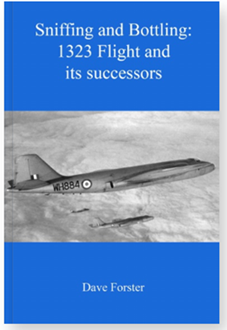
Previously, a book on 1323 Flight had been written by Dave Forster and was published in 2012. The author stated, “Particular thanks are due to Pete Peters for allowing me to quote extensively from his unpublished memoirs Changing Step.”
Book Review:
The history of 1323 Flt, 542 Sqn and 21 Sqn in the nuclear intelligence role 1953-59. The Canberra’s of 1323 Flight sampled debris from Soviet and US atomic tests for scientific intelligence purposes.
The aircraft also participated in the joint US-UK MUSIC programme to determine Soviet plutonium production. "Sniffing and Bottling" also includes the first comprehensive account of RAF participation in the US Operation Castle hydrogen bomb trials of 1954, based on recently-declassified documents and the recollections of participants. It contains many previously unpublished photographs.
Note. 1323 Flight under their own British-designated “Cover” codename Operation Bagpipes, participated in the U.S. Operation Castle nuclear test series in 1954. The flight was involved in sampling the radioactive clouds from the U.S. hydrogen bomb tests, which had yields ranging from 110 kilotons to 15 megatons. The British government used the data collected to develop its own hydrogen bomb, which was successfully tested during Operation Grapple in 1957-1958. The following table shows selective nuclear test yields where tests sampled by 1323 Flight can be compared against those tests sampled by 76 Sqn – both of which can be compared against the yields of the bombs dropped on Japan.

Canberra B6 Navigator Joe Pasquini – 76 Sqn
A year later, in 2020, former RAF Canberra Navigator Joe Pasquini released “Curse of the Nuclear Cloud Flyers”. A 76 Squadron veteran, Pasquini had flown through the 3 megaton Grapple Y test cloud in 1958. He survived seven bouts of cancer. His widow, Roberta, recalled how “writing the book kept him alive”. Pasquini described his publication as “a small compendium of just a few of the investigative reports that document the barbarism conducted by the MoD, all condoned by the British Government.”

Book Review:
There was a serious disconnect between what they were told at the time by the Nuclear Task Force Command and what actually occurred.
Digging out other facts led to a series of probes into what did take place. In summary, the investigative reporting revealed the malfeasances perpetrated by the British Government, through the MoD, in using military personnel as ‘guinea pigs’ throughout the entire nuclear weapons development programme.
The MoD manipulated the data and information. It manipulated the entire legal system and denied the truth.
YET ALTHOUGH THE DATE RANGE OF THE CRITERIA FOR THE NUCLEAR TEST MEDAL WAS DEFINED AS BETWEEN 1952 AND 1967, 1323 FLIGHT ALONG WITH 543 SQUADRON WERE OMITTED WHEN THE FIRST MEDAL WAS ISSUED IN NOVEMBER 2023!
Point 2 – Intelligence Gathering of foreign nations' conflicting decisions
In April 2023, Shadow Defence Secretary John Healey raised a written question regarding 543 Squadron and the criteria for the Nuclear Test Veterans Medal

The Daily Mirror also featured an article on 543 Squadron

So, the Government and the MoD would have been aware of the squadron’s involvement in air sampling “Intelligence Gathering” operations from 1966 to 1974. Six months before the medal was to be issued.
Point 3 – 543 Sqn not recognised again in 2024
In 2024, the Daily Mirror published 3 articles featuring 1323 Flight and 543 Squadron.


In November 2024, there were amendments to the criteria and eligibility requirements, one of which was the recognition of 1323 Flight personnel, YET 543 SQN WERE AGAIN OMITTED!
Point 4 – No recognition of 27 Sqn sniffers
There was also no recognition by the Government / MoD of 27 Sqn Vulcans, who had taken over “Intelligence Gathering” operations from 543 sqn. 27 sqn carried out its role of air-sampling atmospheric nuclear clouds of foreign nations from 1975 to 1980.
Note: The last atmospheric nuclear test was carried out by the Chinese in 1980.
SITREP & ASSESSMENT 1 JANUARY 2025
What is the problem? I don’t know!
The following table shows the extent of the RAF’s involvement in ATMOSPHERIC air-sampling operations between 1952 and 1980. The main keyword is ATMOSPHERIC.

As can be seen, the number of atmospheric nuclear tests air-sampled for the “Development of the UK Nuclear Test Deterrent” is approximately the same as the number air-sampled for “Intelligence Gathering”, and the sampling periods are roughly the same.
When it comes to the number of tests sampled (51) for Intelligence Gathering, 40 of these atmospheric tests were sniffed by 543 sqn alone, between 1966 and 1974 (over 8 years).
YET 543 SQN HAD BEEN IGNORED AGAIN, AND 27 SQN WERE NOT IN THE EQUATION. THE QUESTION IS WHY? MY ANSWER IS “I DON’T KNOW!”
27 SQUADRON - The Flying Elephants
History 1915 to 1969

Foreword by Air Marshal Sir Andrew McKee. No. 27 Squadron of the Royal Flying Corps (RFC) was formed at Hounslow Heath Aerodrome in London on 5 November 1915 and equipped with G-100 Elephant aircraft. The fighter-bomber aircraft was affectionally known as the "Elephant" due to its relatively large size and lack of manoeuvrability. By 1918 the squadron was equipped with D.H.4's and was on day bombing duty. The author describes the many facets of the long and illustrious history of No. 27, its aircraft, and the many men who served in the Squadron during the World War I period.
Considering the squadron is over 110 years old, the squadron's history is complex, having been disbanded and reformed on many occasions, which has naturally involved many types of aircraft. Recommended reading is the Wikipedia page No. 27 Squadron RAF - Wikipedia
Squadron Badge and Motto

The squadron's heraldic badge features an elephant.
First used in 1934, it was approved by King Edward VIII in October 1936.
The use of the elephant refers to the Martinsyde G.100, which was known as the “Elephant” and was the squadron's first operational aircraft.
The elephant is also a species native to India, reflecting the squadron's time there during the Second World War.
The squadron's motto is Quam celerrime ad astra - Latin for “With all speed to the Stars”.
Cold War – 27 Sqn Vulcans at RAF Scampton 1961 to 1982

Strategic Nuclear Strike Force role 1961 to 1971
During the Cold War, in April 1961, the squadron reformed again at RAF Scampton, as the first squadron to be equipped with the Avro Vulcan B.2 and forming part of the United Kingdom's strategic nuclear strike force, known officially as the “V force”. The squadron's Vulcans were equipped with the Blue Steel one megaton stand-off bomb.
It was intended to equip the Vulcan B2 aircraft with the USA Skybolt Air Launched Ballistic Missile to replace the Blue Steel, with the Vulcans being modified to fit pylons, which would carry two Skybolts under the wings. When the Skybolt missile system was cancelled by U.S. President John F. Kennedy on the recommendation of his Secretary of Defence, Robert McNamara in 1962, Blue Steel was kept on.
After the British Polaris submarines became operational and Blue Steel was taken out of service in 1970, the eight aircraft of 27 sqn were each re-equipped with a “WE.177B” parachute-retarded laydown bomb, which was a primary air-dropped nuclear weapon with a 450-kiloton yield.
The squadron was then assigned to NATO's Supreme Allied Commander Europe (SACEUR) in a low-level penetration role, which would provide tactical support for ground forces resisting a Soviet land attack into Western Europe by striking targets assigned by SACEUR, beyond the forward edge of the battlefield, and deep into enemy-held areas. By the end of 1971, the squadron had relinquished its nuclear delivery role and stood down.
Maritime Radar Reconnaissance (MRR) role from 1973 to 1982.
In November 1973, as a result of the planned disbandment of the Victor B2SR-equipped No. 543 reconnaissance Squadron, No. 27 Squadron reformed at RAF Scampton, equipped with the Vulcan as a replacement in the maritime radar reconnaissance role.
The squadron carried out patrols of the seas around the British Isles, flying at high level and using the Vulcan's H2S radar to monitor shipping.
Secondary role of atmospheric air sampling 1975 to 1980
No. 27 Squadron also inherited its secondary role of air sampling from No. 543 Sqn. This involved flying through plumes of airborne contamination and using onboard equipment to collect fallout released from both above-ground and underground nuclear tests of the Chinese, for later analysis at the Atomic Weapons Research Establishment at Aldermaston.
External air-sampling pods and radiation sensor

Five aircraft had small pylons fitted to the redundant “Sky Bolt” hardpoints, which could be used to carry sampling pods, which were modified ex-Sea Vixen drop-tanks
These pods would collect the needed samples on a filter, while an additional smaller "localiser" pod (Radiation Sensor) was fitted to the port wing, inboard of the main pylons.

In December 1973, 27 sqn reformed at RAF Scampton, again with the Vulcan B.2 but in MRR role assigned to Supreme Allied Commander Atlantic.

The squadron's Vulcans were modified and re-designated as "Vulcan B.2 (MRR)" variants to carry radiation sensors and underwing “sniffer” equipment to detect and collect samples of airborne contamination for later analysis at the Atomic Weapons Research Establishment at Aldermaston, Berkshire.
The samples were collected by flying through the high-altitude dust cloud of a ground-based test or the downwind contamination of the upper atmosphere after an atmospheric nuclear air burst.
MMR Paint scheme - Shiny Vulcans of 27 Sqn
There was a noticeable difference in the external presentation of the MMR variants of 27 sqn Vulcans with the new “Shiny” high-gloss polyurethane finish, rather than the standard matte camouflage. The reason for this was that the high-gloss paint provided a protective layer against the corrosive effects of salt water and made the airframe easier to clean. This was crucial for washing off the potentially ionising radioactive dust particles collected during sampling
This was rumoured to be authorised by Wing Cdr Willis, the 27 Sqn Boss, allegedly without the AOC knowing.
AROMA sniffing operations from Shemya and Midway Island.
A list of Aroma files held at The National Archives (TNA’s) at Kew and the sniffing operations carried out by 27 Sqn between 1971 and 1982 is shown below:


As can be seen, 27 Sqn sampled in the region of 11 atmospheric tests. In 1976 and 1978, detachments to Midway Island were arranged so there was a turnover of personnel at approximately 6 weeks.
AROMA 6 – 27 Squadron at SHEMYA ISLAND AFB 1976
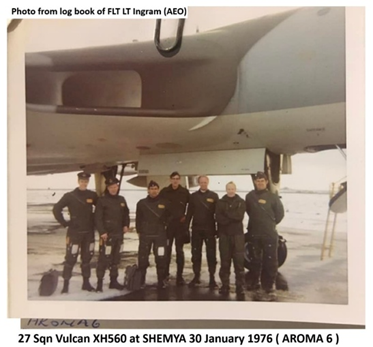
There is little information to be found online, however, there is a photograph of 27 squadron at Shemya which coincided with the Aroma 6 (CHIC-18) timescale.
A photo from one of my dad’s log books showing Captain Flt Lt Marman, Flt Lt Ingram (AEO) Crew Chief Wally Hammond (Centre) and others. Simon-Rebecca Ingram
There is, however, a detailed account of 543 Squadron online of sniffing out of the USA Shemya Air Force Base in 1970.
It is a bit of a surprise to see the Vulcans flying out of Shemya, after 543 sqns disparaging feedback when they air-sampled Chinese test CHIC-11 in 1970, six years prior. A brief account can be found in an “Key.aero” article by Tony Butler, an extract of which is detailed below. Note the Yield!
The Victor's little-known nuclear sampling role
543 Victor Squadron Sampling the Chinese in 1970
Air electronics officer (AEO) Flt Lt Mike Beer, who took part in detachments by 543 squadron to “Sniff” Chinese nuclear tests at Shemya in the Aleutian Islands, Alaska. writes “we tried a different launch for the first Chinese airborne test from Lop Nur in October 1970 using Victor XL161.”
Shemya is an inhospitable spot, very close to the Russian Border, with a long runway but foul weather: wind, rain, low mist/fog and snow/ice all in a day. It was covered in various aerials. The aircraft were tugged into the hangar as soon after landing and as safely as possible, and before they iced up. We lived in rooms above. I flew with Tom Barnard on local familiarisation sorties, including practice diversions to Cold Bay and Adak in Victor B2SR XL161 on October the 4 and 6, 1970. It was good practice to check out local diversions before you needed them in extremis. The diversions of Adak and Cold Bay fared little better with the weather and were shorter, I think.
Tony Hudson launched on the 15th when the cloud was predicted as within range. He made a successful collection landing back at Shemya. The samples were considered sufficient, and Tom and I launched in XL161 with a lead box (containing radioactive samples) the following day on a delivery sortie to McClellan Air Force Base, California for handover to AWRE and dispatch.
We completed the detachment successfully, BUT NEVER RETURNED, changing to the warmer climes of Midway for subsequent operations

AROMA 11 – 27 Squadron at MIDWAY ISLAND AFB 1980
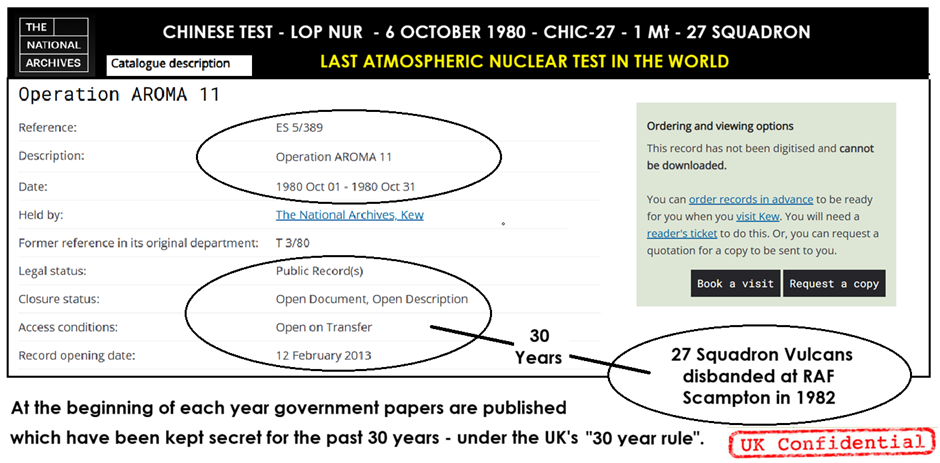
The last atmospheric nuclear test in the air was air-sampled by 27 sqn under the code name AROMA 11.
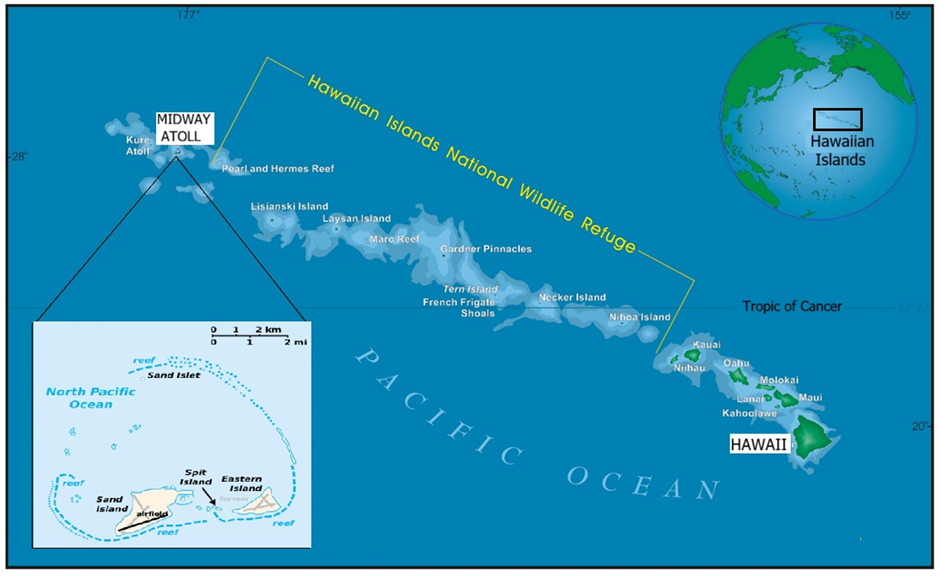
The squadron disbanded at Scampton on 31st March 1982, passing on its MMR radar reconnaissance duties to the RAF's Nimrods and its air-sampling capability to the VC10’s of 101 Sqn.
27 SQUADRON – PUBLICITY AND SECRECY
From my research, 27 Sqn Vulcans at Scampton were never shy when it came to publicity.


Yet, when it came to the covert air-sampling operations, due to the 30-year rule and the Official Secrets Act, there was a natural reluctance to talk about the “Elephant in the Room”.
The Official Secrets Act.
The "30-year rule" refers to the UK government's practice, under the Public Records Act, of transferring historical records to The National Archives after 30 years for public release, though this timeframe was reduced to 20 years by the Constitutional Reform and Governance Act 2010. This is distinct from the Official Secrets Act 1989, which governs unauthorised disclosure of information.
The 30-Year Rule (Now 20 Years):
To balance government secrecy with public access to historical records.
Reduced from 50 years to 30 years in 1967, then further reduced to 20 years in 2010.
Government records are transferred to The National Archives after 20 years, with provisions for exemptions (like national security) that are also reviewed.
Official Secrets Act (OSA) 1989:
Came into force in 1990. Criminalises unauthorised disclosure in specific areas (security, defence, intelligence, crime, etc.).
Seen by some as overly broad and a barrier to public interest disclosures, leading to calls for reform and better whistleblower protections.
The 30/20-year rule is about access to historical government information, while the Official Secrets Act deals with unauthorised disclosure of current and historical official information.
PPRuNe Web Site and Self-Moderation

For RAF personnel, it is a forum application started in 1993 to recall memories and activities of their operational experiences. For researchers, it is a useful source of information, which I have used intensively.
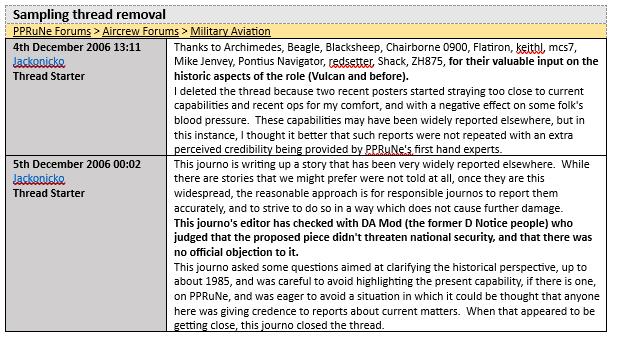
Admin/moderators monitor content and can delete posts if considered inappropriate and archive threads if need be. An example is shown below:

Note that the above thread, raised in 2004, lasted less than a day and was closed. The content obviously referred to Vulcan sniffing operations from 1975 to 1980 carried out by 27 sqn, which was disbanded in 1982. Applying the 30-year rule and evaluating the content, the moderators decided that it was apt to close the thread. As the thread starter said, “Looks like I will have to wait until 2012 then. Shame many tales will be lost by then”.
The following thread started 2 years later in 2006, obviously generated many responses, but the thread starter decided to delete it after he considered that posts would likely impact upon current RAF sampling operations. In 2006, the VC10’s of 101 Sqn were still undertaking intelligence gathering air-sampling operations on Nuclear Tests being carried out by foreign nations. These tests, of course, were no longer Atmospheric nuclear tests.
One can only imagine the loss of historical content of the 12 posters (from 1966 to 1980) whose input was deleted. All this was lost, even though it didn’t threaten national security!
The effect of the “Official Secrets Act”
RAF personnel involved in Sniffing operations were told “not to talk about them” and were aware of the “Official Secrets Act” which they had all signed whilst in service - they kept quiet. In the case of 543 Sqn, who “sniffed” from 1966 to 1974, it took 30 years until word began to spread about the numerous reports of cancer and health problems, family miscarriages and early deaths that were occurring to ex-members of 543 squadron, before people put their heads above the parapet.


As can be seen from the above examples, the two groundcrew of 543 (Chris the Sage and Wapley) waited around 35 years after 543 sqn stopped sniffing to join PPRuNE and start a thread.
Graham Rumbellow, another ex-member of 543 Sqn, took 14 years after the posts appeared on PPRuNE to respond in 2023 - obviously, this is just one person who was missed by the Tribunal Services. One wonders how many more members of 543 sqn would have become involved if only they had known of the campaign initiative and/or the PPRUNE website.
In 2010, it was reported in the Guardian newspaper that airmen and ground crew from RAF 543 squadron were also contaminated after flights through French and Chinese nuclear explosions between 1966 and 1974. According to veterans, only 10 of them, or their widows, have been awarded war pensions by the MoD for cancers they contracted.
The salient points here are:
How many 543 Sqn Victor personnel succumbed to cancer-related health problems that could be attributed to exposure to ionising radiation?
How many 27 Sqn Vulcan personnel were similarly affected? 45 years after 27 Sqn stopped sniffing atmospheric nuclear tests, feedback has been limited on PPRuNE.
In both cases, I fear we will never know. What was common for both squadrons was the fact that the sampling aircraft returned to their respective RAF bases heavily contaminated with radiation and had to be washed down and decontaminated by squadron personnel, and then worked on.
YOU DIDN’T HAVE TO BE DETACHED TO FOREIGN LOCATIONS TO BE EXPOSED.
Vulcans returned to RAF Scampton contaminated


Limited Aircrew Feedback - The Elephant in the Room

Unlike 543 Sqn aircrews, there is little feedback found online from 27 Sqn aircrews.
Having read a review on a book called the “The Vulcan Boys” and noted that the contents included mention of monitoring the Chinese Nuclear Tests, I ordered a copy.
Disappointingly, coverage of the Midway Island air sampling mission was more akin to a holiday brochure. There was no mention of possible exposure to ionising radiation.
VC10 SNIFFER ROLE 1982 – 2009

The following Information has been obtained from the “A Little VC10derness” website (29 June 1962 - 25 September 2013)

After 27 squadron stood down the air-sampling role in 1982 (following the last Chinese atmospheric nuclear test in 1980), the next type of RAF aircraft to be sent out to collect air samples was the VC10. Three type K3S: of which it is known ZA150 (Juliet) and ZA147 (Foxtrot) were modified so that they could be sent out on this air monitoring role on the underground nuclear tests that followed.
The purpose of these flights is to gain information on the composition and yield of the weapon used, but information about the distribution of any fallout is also useful, and this ties in to the meteorological aspect of the role.
When needed, the K3 tanker was modified so that it carried two sampling pods on its wing stations instead of the refuelling pods, and a smaller instrument underneath the nose of the aircraft. Inside, an operator's station was provided on the left side of the cabin, on the rear face of the toilet cubicle.
What happened to ZA147
On 25 September 2013, ZA147 took off from RAF Brize Norton around 14:45, and after a flight of around one hour, she appeared just North of Bruntingthorpe, performed two go-arounds and landed at 16:02, bringing to a close a superb career of 51 years. Last ever flight of a Vickers VC10.
In November 2021, the airframe of ZA147 was scrapped at Bruntingthorpe, and the US registration of N147ZA was assigned so that parts could be used in the restoration to flying status of ZA150. The cockpit section was preserved.
What happened to ZA150.
On 20 September 2013, ZA150 flew its last operational sortie together with ZA147. It carried out flypasts at RAF Lossiemouth, RAF Leuchars and Prestwick.
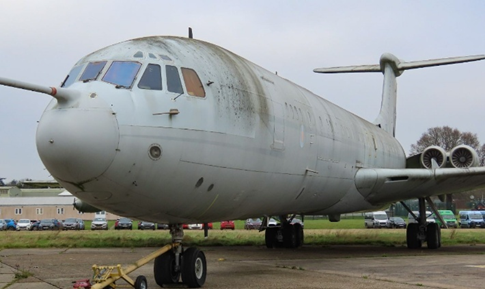
On 23 September 2013, after several weeks of negotiations, “The Brooklands Museum” signed the paperwork to acquire the last VC10 ever built. On 24 September 2013, ZA150 performed its final landing at Dunsfold at 13:43 local time. On 1 July 2020, the airframe was sold to “GJD Aerotech”, who purchased it on behalf of Kepler Aerospace. The plan was to operate the airframe as a tanker in the US to support Kepler's operations. In November 2021, the US registration N150ZA was assigned.
In fact, a report in January 2025 stated that ZA150 is still at Dunsfold, parked right by the entrance and there is no restriction to access.
Crew Comments on VC10 Sniffing Operations

MarkF - 2022
My last mission was to test for atmospheric radiation after North Korea set one off in 2006. At the time, the RAF had three K3 VC-10s that could be converted to carry out the same missions as the American equivalent, the WC-135 Constant Phoenix aircraft.
I believe the kit we used was owned by the AWRE. The detectors and G counters on the floor had date stamps 1952 on them.
Depending on the prevailing winds, we tracked wherever the Met Office guys would send us.
We did analyse whilst airborne. I won’t go into or the technical details. You won’t find much in the public domain.
We look for iodine 131. Each weapon or reactor has a unique signature. The computing onboard can work out the difference between natural background radiation and any anomalies.
We know high doses of iodine 131 ingested in high doses attack the Thyroid. Yes, iodine has a half-life and degrades, but it is highly volatile and highly radioactive after an explosion. That’s what we look for. Samples then go off to either Albuquerque, New Mexico or to AWRE Porton down for the boffins to look at.
Testing the atmosphere after an event can tell us how big the bang was and where the radioactive fallout is likely to go (i.e. prevailing winds). We had a pre-mission brief with the Met Office guys, which is standard before getting airborne, but take it from me, it’s not nice flying through a radioactive cloud.
THE END OF RAF SNIFFING OPERATIONS

Anthony Osborne June 12, 2013: The U.K. Royal Air Force will lose the ability to conduct air sampling for nuclear treaty verification when the last Vickers VC-10 air-to-air refuelling tankers are retired later this year. The little-known and highly secretive mission was passed to the Vickers VC-10 following the retirement of 27 Sqn Vulcans.
101 Sqn VC10’s - Last Nuclear Test Sampling Mission
The North Korean VC10 sniffing operations

in 2009 were the last to be carried out by the RAF.
From then until the present day, the USA has continued to provide data on air sampling of the atmosphere using its three dedicated WC-135 Constant Phoenix aircraft based at USAF Offutt AFB, Nebraska.
North Korea air sampling by both the RAF and the USAF
From information released to the press, it is known that VC10 tail number ZA150 was sent to Kadena Air Base, Japan, in October 2006. Also there, was a USA sniffer aircraft. On October 6, Japan's “Kyodo News agency” reported that a US military aircraft, equipped to detect radiation from a nuclear test, took off from southern Japan. This was believed to be part of USA's efforts to prepare to monitor a North Korean nuclear test. On October 13, 2006, CNN reported: "The U.S. Air Force flew a WC-135 Constant Phoenix atmospheric collection aircraft on Tuesday to collect air samples from the region. A preliminary analysis of air samples from North Korea shows radioactive debris consistent with a North Korea nuclear test”, according to a statement from the office of the top U.S. intelligence official.
In May 2009, a VC10 type K3 was again sent to Japan to collect information on North Korea's next nuclear test. As in 2006, once again a USA sniffer aircraft was present. On June 17, 2009, the JoongAng Daily reported, in reference to a purported May 25 nuclear test by North Korea: "The U.S. Air Force twice dispatched a special reconnaissance jet, the WC-135 Constant Phoenix from Kadena Air Base in Okinawa, Japan, to collect air samples."
2026 – Iranian air sampling by the USAF
The need for sampling continues to this day.

SUMMARY
Because I had been detached to Lima, Peru in 1968 with RAF 543 Squadron (Operation WEB) to monitor the French nuclear test programme, my interest naturally went beyond simply following the BNTVA’s campaign for recognition of nuclear test veterans. This was particularly so when it was decided that recognition would be limited to those involved in the “development of the British nuclear deterrent” between 1952 and 1967.
Personnel who had been involved in “intelligence gathering” on foreign nations’ nuclear tests were effectively being overlooked. Even RAF 1323 Flight appeared to have been excluded, despite their role in monitoring United States nuclear tests in 1954 (within the specified date range) and them flying through nuclear clouds using identical Canberra aircraft as RAF 76 squadron, who had been included.
Something about this did not seem right and could not easily be explained. RAF 543 Squadron and 27 Squadron, which, like 1323 Flt, were involved in intelligence gathering, were, in effect, invisible, even though their service had been identical. As a result, I carried out an evaluation of possible reasons why this could be, as I had been aware that social media had reported that ex-543 personnel had received War Pensions for ill health due to exposure to ionising radiation and ex-543 aircrew had been writing online articles about their air sampling experiences.
What was obvious to me was that whereas the full list of nuclear tests carried out between 1952 and 1967 was readily available on the internet, a list of foreign tests monitored by the RAF wasn’t. As such, using my experience, I set myself an objective to collate foreign nations' nuclear test details and dates (available on Wikipedia) with RAF code-named operations used to monitor them.
As a result, I created a reference document titled 543 RECOGNITION | LABRATS.INTERNATIONAL, which was uploaded to the LABRATS website.
From further research, I created additional articles – all available on the LABRATS website:
In addition to the RAF air-sampling at altitudes around 50,000 feet, there were also ships involved that were sailing through the fallout zones of the French tests, witnessing explosions, monitoring radiation levels, sampling seawater and collecting air-samples.
SS Camelot, a merchant navy vessel, was used by the UK Government to sail through the fallout zone of the French Tests of 1968.
RFA Sir Percivale was involved from 1970 to 1974
This article about 27 Sqn contains all the facts that I have accumulated, together with the above articles, is a useful set of signposts and reference documents for those who wish to research further RAF “Atmospheric Nuclear Test Clouds” air-sampling operations. Please note that all the open-source data detailed in this document has been found on the internet.
Further research by reference to AWE files held by The National Archives at Kew is recommended.
Barry Fagg - 7 March 2026.
Download the blog as a PDF by clicking the link below:


I was at McClellan from 1977 to 1980. There were 3 RAF personnel, Flt Lt Supply/Movements Officer (D J Taylor), Sgt Gen Tech E (Terry Hempsal) and me a Sgt Gen Tech GSE (Dave Gardner). I did some local OJT on 27 Sqn at Scampton and was later authorised iaw AP100B-01 to do minor work on the Vulcans (outside of my trade boundaries). This authority was renewed 6 monthly during a 27 Sqn deployment. I well remember the Sengo being Sqn Ldr Smith on mant occasions. We handled the aircraft for departure/arrival and trans transfered the samples to the Labs of Lawrence Livermore. (Wally Hammond and other crew chiefs were regular quests at our dinner table). They were wonderful company…
The history of the Vulcan XH558 is truly fascinating, especially regarding its specialized role in the 27 Squadron. Much like how Fang helps manage complex operational sequences, the technical coordination required to maintain such an iconic aircraft for its secret missions is an impressive feat of aviation engineering.
I was also stationed at RAF Scampton from 1974 until I was demobbed in November 1978 .I was a fireman and therefore had lots of contact with Vulcan aircraft of 27 Sqdn. Mainly we had to meet the aircraft when they landed and make sure their brakes were not over heated on landing . This intailed a physiclal check before they were allowed to proceed to their dispersal pan. We were also involved in wash downs when venting occured on the dispersal pans.Also many hours sat in our fire vehicles whilst the ground crew did engine runs in the dispersals. Lots of other contact with the aircaft associated with our contination training.
The point I am making is that nuclear…