
CAMELOT & SIR PERCIVALE


Introduction
President Charles de Gaulle insisted on maintaining a fully independent nuclear deterrent (force de frappe) which France had established during the Cold War; that was free from dependence on either the USA or NATO. France’s first nuclear tests were carried out between 1960 and 1966, were conducted at Ekker in the Sahara Desert in what was then French Algeria. This consisted of a series of 13 underground nuclear tests and 5 complementary subcritical atmospheric experiments. With Algeria becoming independent, France could no longer rely on Algerian territory for long-term nuclear testing, and facing substantial backlash and opposition in European countries, it needed a secure location under full French control and administration, far from major populations, and geographically isolated in case of accidents or fallout. Therefore, in 1966, France moved their atmospheric test programme to the Tuamotu Archipelago of French Polynesia which met all these criteria; with the main aim being to develop a thermonuclear weapon. Between 1966 and 1974 France conducted 46 Atmospheric nuclear tests in the Mururoa and Fangataufa atolls, achieving their first Thermo-nuclear test in 1968.
Between 1952 and 1967 the UK had also developed its own “Nuclear Deterrent” and the Royal Air Force (RAF) had over 15-years established a method of monitoring the yield and content of the British atmospheric nuclear tests, by air-sampling the debris from the resultant radioactive clouds. A task deemed necessary by William Penney for “Development Purposes”, which was fully endorsed and supported by the UK Government.
From 1966, the RAF role was changed to that of “Intelligence Gathering” by air sampling test clouds of foreign nations in what was then covert operations. This involved flying at “high altitude”, through the test clouds of both China and France, which involved the use of specifically modified Victor aircraft of 543 Squadron, who air-sampled 40 tests over an 8-year period from 1966 to 1974. Air-sampling (known as Sniffing) is a high-risk activity with a high probability that the personnel involved are being exposed to ionising radiation.
Overview of the Nuclear Test Medal
In November 2022 the Nuclear Test Medal was “officially announced” (to coincide with the 70th anniversary of the UK’s first nuclear test), to recognise the service of personnel involved in the UK's nuclear weapons testing programs from 1952 to 1967, honouring their contributions and sacrifices in the development of the “UK’s Nuclear Deterrent”. There was no recognition of those personnel involved with “Intelligence Gathering” of foreign nations nuclear tests, who carried out identical tasks from 1966 forwards.
The medal was “officially issued” a year later in November 2023, and following a 2-year campaign by LABRATS for recognition, the eligibility and criteria for the medal was extended in November 2025 to include the RAF personnel of 543 Sqn Victors and 27 Sqn Vulcans who carried out the air-sampling of foreign “Atmospheric nuclear tests” from 1966 to 1980.
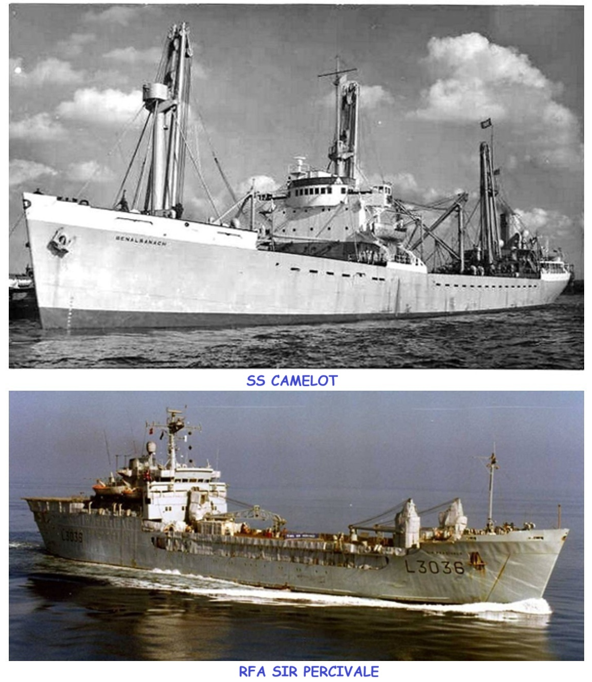
Also included in the extension were the Royal Navy, Royal Fleet Auxiliary (RFA) personnel and the civilian crews of RFA Sir Percivale, who sailed through the “fallout” of the French Atmospheric Nuclear tests between 1970 and 1974, and who collected sea water samples for analysis and air-sampled the debris of the nuclear clouds by the use of monitoring equipment fitted on a tethered Helium balloon flown at heights up to 10,000 feet. This article, describes how the unpublicised and secret role of RFA Sir Percivale was discovered and brought to the attention of the Office of Veterans Affairs (OVA) at the MoD and thus to the Secretary of Defence John Healey MP. During the research on Sir Percivale it was discovered that before it had become involved in 1970, a merchant navy ship called Camelot had sailed through the fallout of the French Tests in the summer of 1968.
Research
As author of this report, I would like to emphasise that the affairs of the Royal Navy, the Royal Fleet Auxiliary (RFA) and the Merchant Navy is far from my level of expertise and knowledge. My research is mainly carried out online using Wikipedia, search engines, Artificial Intelligence (AI) applications such as ChatGPT and Co-Pilot, and more specifically by reference to the information discovered by access to open-source data and personal information posted on social media such as Facebook and historical and nostalgia forums. I try to ensure the information provided in this document; that I have researched, collected and collated is to the best of my ability and I apologise for any errors. Barry Fagg.
Pitcairn Island - a British Overseas Territory - Facts and Governance

Pitcairn Island, 9,264 miles from London, is the last remaining British Overseas Territory (BOT) in the Pacific and its geographic isolation and with the world's least populated territory, serves as a key example of how smaller territories, the remnants of the British Empire, continue to be sources of contention. In the 1960s as is now, the British government had a duty to safeguard these smaller territories and their populations, and through the Governor of Fiji they were directly responsible for Pitcairn’s welfare.
Following Fiji’s independence in 1970, formal administrative responsibility shifted to the British High Commissioner in Wellington, New Zealand, marking the point at which New Zealand’s role in day-to-day support became more direct. New Zealand’s role after 1970 was practical/logistical, not sovereign, thus the UK never ceded constitutional responsibility.
French Nuclear Tests and the Potential Risks
The challenges to the Labour party government of the day, that of administrating Pitcairn were heightened in 1966 when the French government began conducting atmospheric nuclear tests on Moruroa, an island in French Polynesia, located 602 miles upwind from Pitcairn. This raised concerns of the potential contamination to the territory from nuclear fallout and the dangers and safety of the residents which numbered less than 100. The UK was thus obliged to address economic and political implications and meetings were held in Paris regarding nuclear testing in the Pacific, focusing on both health and safety concerns.
These talks concluded that the French were unable to provide conclusive evidence that all risks to the inhabitants of Pitcairn could be entirely ruled out requiring the UK government to take action to protect the islanders.

UK Response – Radiation Monitoring Introduced

The action taken by the UK Government was to install monitoring equipment on Pitcairn Island, and in 1966 and aware of the pending test programme dates, two RAF technical personnel were transported to Pitcairn by sea for the duration of the atmospheric nuclear tests to monitor and record the radiation levels.
The report of this action can be found in Air 2/17843 held by the National Archives at Kew.
Hansard References to Pitcairn from 1966 to 1973
Hansard records all Parliamentary debates in the House of Commons and the House of Lords. You can search, browse and find debates, divisions, petitions and MPs or Lords by date.
In a search of Hansard, there appears to be no record between 1966 and 1971 in which MPs or Lords, raised a question about radiation monitoring on Pitcairn in the context of the ongoing French atmospheric test series. The first appearance that can be found is 23 June 1972 which refers to a “Written Question” by Mr. Farr on “Pitcairn Island (French Nuclear Test)”.

Mr. Farr
Asked the Secretary of State for Foreign and Commonwealth Affairs if he will make a statement on the action taken to protect the health of the British Pitcairn islanders in view of the forthcoming French nuclear test in the area.
Mr. Anthony Royle
As in previous years we have informed the French Government of the Royal Air Force team on Pitcairn sent to conduct health monitoring throughout the period of the French nuclear test programme. The French Government are aware of our concern for the wellbeing of the islanders. The Governor of Pitcairn has informed the inhabitants that Her Majesty's Government have taken all necessary precautions to protect their safety and health and that no danger is expected. As one of the parties to the Partial Test Ban Treaty of 1963 which prohibits nuclear tests in the atmosphere, Her Majesty's Government maintain the hope that those countries which have not done so will eventually decide to accede to the Treaty.
Lack of references in Hansard for 6 years
One would expect that given the perceived risk to human health and the sensitive nature of nuclear tests, the welfare of British-administered peoples on Pitcairn would have been raised in Parliament sooner than 6 years after the UK Government had begun conducting radiological surveillance.
The lack of public disclosure was more than likely the normal routine in the 1960s as many Cold War monitoring missions (including for the French and Chinese tests) were carried out under the Defence Nuclear Safety umbrella and not discussed unless MPs specifically asked. Additionally, maybe Pitcairn and the of risk exposure were not mentioned in Parliament, because it was not considered a subject for debate. Monitoring may have been treated as a technical exercise for UK defence intelligence, not a humanitarian safeguard.
Not in the national interest – British National Monitoring System
A classic example of a written answer to a question by Mr Swingler in 1962, on nuclear test monitoring illustrates how the UK Government was playing its cards close to the chest, to keep their plans or intentions a secret.
This basically set the standard response, when questions were asked on nuclear test monitoring of Foreign Nations.

Mr. Swingler
asked the Lord Privy Seal what is the total number of nuclear tests of all kinds which have been monitored to date by the British national monitoring system; and if he will state respectively the numbers of tests held by the Soviet Union, the United States. Great Britain, and France.
Mr. Heath
There have been 22 British nuclear tests. 195 United States tests have been announced by the United States Atomic Energy Commission. The French Government have announced four French tests. About 100 Soviet tests have been reported.
It would not be in the national interest to give details of tests monitored by the British national monitoring system. I can only say that our system has recorded signals from certain nuclear tests.
In 1973, during two debates on French Nuclear Tests in June and July, questions were raised.

Mr. Judd
asked the Secretary of State for Foreign and Commonwealth Affairs what progress has been made in making arrangements for monitoring the fall-out from the forthcoming French nuclear tests in British dependencies in the Pacific.
Mr. Amery
We have as a precaution stationed a two-man team on Pitcairn Island. In the event of a French test series, the team will, as in previous years, conduct radiological monitoring. The team were landed on Pitcairn by the RFA Sir Percivale.
Mr. Dalyell
Precisely what is meant by the phrase "as a precaution"?
Mr. Amery
Previously, when there have been tests, we have stationed teams to monitor their effect, and so far, as the Honorary Gentleman knows, the tests have led to no increase in radiation.

Mr. Dalyell
Our concern is with the possible risks from fall-out and the effect of any rise in background levels of radioactivity which will result from continued atmospheric testing. It so happens that we are responsible for the nearest centre of population to the French testing ground—the Pitcairn Islands.
When I was at the atomic tests at Christmas Island what worried us most was not so much the radiation that would follow if the bomb went off according to plan but what would happen if the bomb went off accidentally by dropping into the sea. Has my right hon. Friend made any estimates of what the effect would be on Pitcairn if anything went wrong with the French tests?
Therefore, I must ask where the Foreign Office is obtaining its scientific advice. The House deserves to be told who is giving it. In particular, may we be told about the terms of reference, the functions and the reports of the two men who have been seconded to the Pitcairn Islands?
Mr. Amery
I understand that Australian and New Zealand experts have recently visited the French test site and have been able to see for themselves the precautions which the French are taking and have not represented, to me, at any rate, or to us, that the French precautions are inadequate however, in order to reassure ourselves and the Pitcairn islanders on this point we have this year, as in past years, made arrangements to carry out radiological monitoring.
There are two RAF technicians on Pitcairn itself to carry out this monitoring, and the Royal Fleet Auxiliary RFA Sir Percival is also stationed in the area.

Baroness Tweedsmuir of Belhelvie
Past experience has given us no reason to doubt that French safety precautions taken in connection with their tests are such that there is little possibility of any danger to the Pitcairn Islanders, which is what we are concerned with to-day.
However, my Lords, we wish to reassure ourselves and the inhabitants, and therefore we have this year, as in past years when French tests have taken place, made arrangements to conduct radiological monitoring in the area and the Royal Fleet Auxiliary (RFA) SIR PERCIVALE IS “ON STATION-AT-SEA” and two RAF technicians established on Pitcairn Island itself. I am glad to say in the context of this debate that during previous test series similar monitoring has never recorded levels of radioactivity which were any danger to health or to any environmental aspect of Pitcairn Island.
Safety of Pitcairn residents and exposure to radiation.
So, following reassuring statements from both the Commons and the House of Lords in 1973, after seven years of monitoring by RAF Technicians temporary based at Pitcairn during the years that the French carried out the tests, there had been no evidential risk to Pitcairn Island and its residents.
First mention of Sir Percivale on Station.
In 1973, we have the first mention of RFA Sir Percivale, yet no details of its operational role, where it was positioned at sea during the French tests and how many times had this ship been involved in monitoring since 1966.
Maybe a clue lies in the title of document ES 13/15, a closed record, retained by the MoD.

General Intelligence; Monitoring and Sampling Operations
Sixty years after the first French Atmospheric test that was carried out in the Pacific in 1966, and thanks to open-source information and personal stories on historical and nostalgic forums from people who were there, today the extent of “intelligence gathering” on the French Atmospheric Nuclear Test Series in the Pacific can now be revealed.
Pitcairn Radiation Monitoring – by RAF Technicians
Every year from 1966 until 1974 (with the exception of 1969), the French Nuclear Tests were monitored by various Royal Air Force Technicians who were detached to Pitcairn. Two technicians would usually fly from the UK to Balboa (located adjacent to the Panama Canal) and then be picked up and transported by sea to Pitcairn, where they would operate the radiation monitoring equipment that had been installed on the island.
Note: France did not conduct nuclear tests in the Pacific in the year 1969 because it had already carried out its major atmospheric thermonuclear test in 1968 (Operation Canopus) and then paused before resuming further testing in 1970. The gap was due to technical and logistical reasons, notwithstanding international political pressure.
High-level nuclear Test Cloud air-sampling by RAF 543 Victor Squadron
Between July 1966 and September 1974, Victor aircraft of 543 Squadron were involved in air-sampling missions of 27 French Atmospheric Nuclear Tests. Flying out of Lima, Peru there were 4 different Operations WEB (1968), ALCHEMIST (1970), ATTUNE (1971) and VELLUM (1974); using combinations of 4 specifically modified aircraft – Tail Numbers XL161, XL165, XL193 and XL230.
Note: Articles relating to these missions can be found on the LABRATS Web site as follows:
Low-level nuclear test “Fall-out” air-sampling and sea water analysis.
Every year (with the exception of 1969) the UK Government utilised two ships; Merchant Navy SS Camelot (in 1968) and Royal Fleet Auxiliary (RFA) Sir Percivale (from 1970 to 1974), to sail through the Fallout Zone of the French Atmospheric Nuclear tests.
On-board would-be a mix of; Royal Navy (Radio Operators), scientists from the Atomic Weapons Research Establishment (AWRE), RFA personnel and the civilian crew. In the case of SS Camelot, the crew would have included Merchant seamen.
SS Camelot
There is no obvious or official recognition of Merchant Navy ship SS Camelot by the UK Government and its involvement with transporting AWRE Scientists to the South Atlantic to sail through the fallout of the French Nuclear Test of 1968. However, through the open-source information available on the internet, the following forum posts (since 2008) were noted, which clearly proves SS Camelot’s involvement.

“SHIPS NOSTALGIA” Extracts
DRT
August 30, 2008
I came across the “Camelot” (ex-Benalbanach) in 1968, I was a cadet on RFA Orangeleaf and we went down to the South Pacific to restore and refuel her. She was loaded up with monitoring equipment - essentially spying on the French A tests which were underway on Mururoa.
The RAS was an interesting event as her bunker point was in a hatch on the ships side.
The scientists we carried boarded her by “jack stay” transfer.
camelot
Aug 23, 2010
Hi, I Have Just Joined Ships Nostalgia. Would like to contact anyone who served on the “Camelot” when she observed the atomic test in the pacific summer of 1968.
camelotpacific
Aug 24, 2010
Camalot, did indeed sail on the “Camelot” as engineer during that summer. From memory Will Smellie was Chief Engineering Officer (CEO), Tom Copeland 2nd Engineer, Bob Burden and Jim McMillan. Can't remember the other 3 engineers. Most happy and memorable ship. Many Regards.
Peter Fielding
Aug 24, 2010
Although I wasn't aboard “Camelot” when she was down in the Pacific, I did join her in Southampton on her return to UK, October 16th. 1968. We sailed the following day, and anchored off the Isle of Wight for about a week, while the boffins from Aldermaston calibrated their equipment in uncontaminated air.
I was J/E at the time, and remember that the Chief was Bill Smellie, Tom Copeland was 2nd. I also remember Jimmy McMillan, Pete Nicholson, John McPhail, Bob Hughes and Mark James, though which of them did the voyage, and which were relieving I couldn't say. The Mate was Harry Duff.
From the IoW we went up to Marchwood, and moored to the jetty at Husband's Shipyard. The boffins and their equipment were landed, and we settled down to a very undemanding existence.

SHIPSPOTTING” Extracts

Feb 27, 2012
Hi Doug, Perhaps the radioactive air took her paint off.
It is not a great photo scan but it looks a lot better than the faded original.
Hope it bought back some memories.
Regards, Bob
Feb 15, 2021
I sailed on deck on her as EDH. Joined her 29/05/68 Southampton “left at Smoko” on the Poop deck and the RAS we did with the RFA Orangeleaf.
What a trip not many have experienced what we did. Please get in touch as you could be on the photos. Regards, Karl Daneil Wismann known as Danny from Cardiff.
Feb 27, 2012
Bob, can confirm this is the former Empire Athelston, Benalbanach, and Camelot. This was my first ship, joined 15/05/68 as a lowly JEO managed by BISN for MoD, name Camelot.
Spent the Summer steaming round the Pacific with Bods from Aldermaston and RN monitoring the French atomic tests. Looks like the photo is taken of her on Husbands Jetty, Marchwood. Doug.
“R F A SHIPS” Facebook Page Extract
Sept 28, 2025
I was on a ship called the “Camelot”; we were monitoring the French atomic tests in 1968.
I saw 5 bombs tested including the first H bomb the French tested. We were told we were 40 miles from the test area and we would be safe. I don’t think so as the radiation cloud passed over the ship.
We were at sea for three and a half months and we were replenished by the RFA Orangeleaf.
Onboard the Camelot we had atomic scientists also Royal Navy personnel who operated the monitoring equipment.
We were told a Merchant ship should be used instead of a RN ship.
The Americans also had a ship there as well called the “Catsfield” who were also monitoring the atomic tests. I have searched the internet but nothing has been mentioned about a British ship monitoring the tests just the RAF.
RFA Sir Percivale “On Station at Sea”
In November 2025, the criteria and eligibility requirement for the Nuclear Test Medal were extended to include the Royal Navy service personnel, and the RFA and civilian crews of RFA Sir Percivale, who sailed through the “fallout” of the French Atmospheric Nuclear tests between 1970 and 1974.
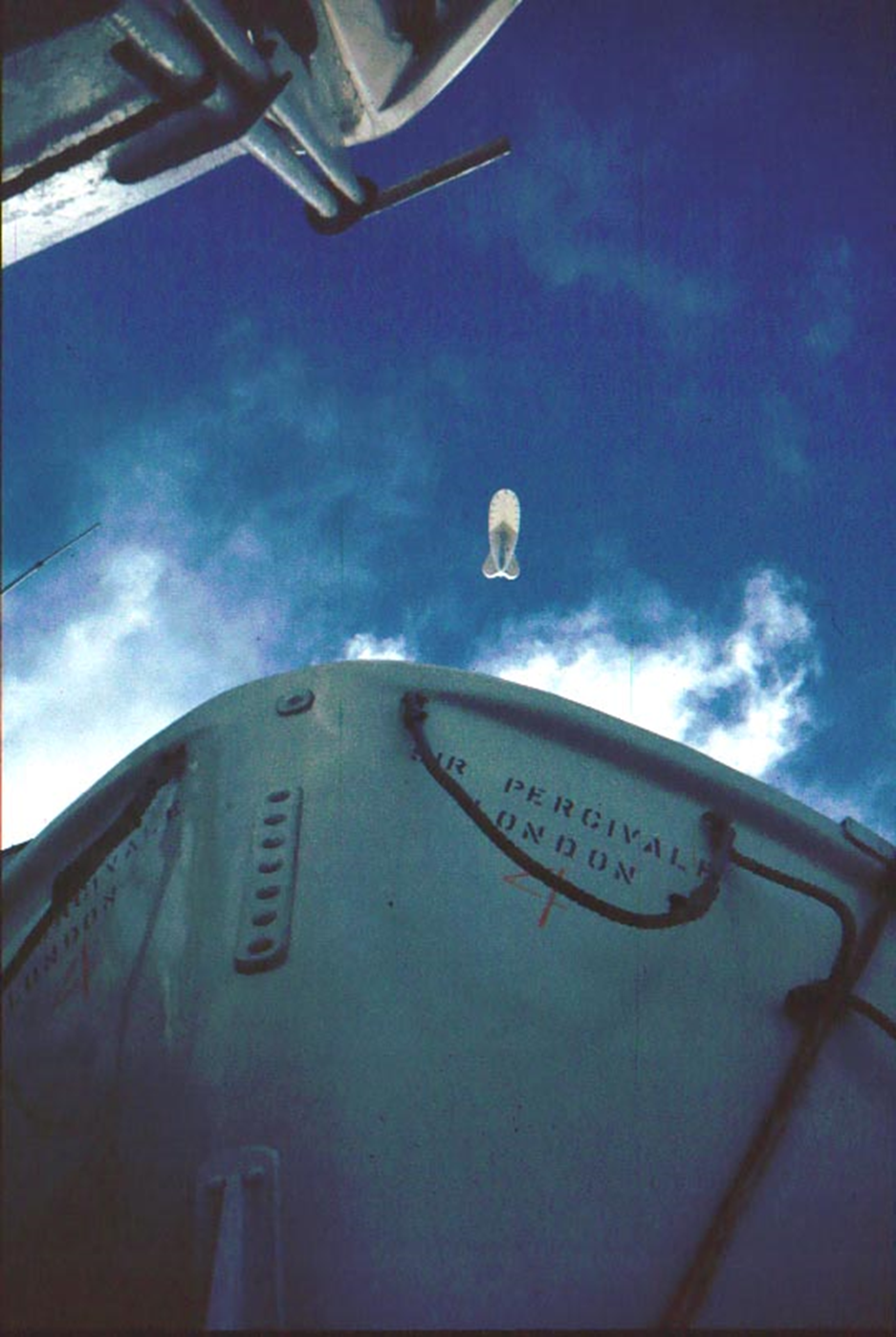
The operation included the collection of sea water for analysis and air-sampled the debris of the nuclear clouds by the use of monitoring equipment fitted on a tethered Helium balloon flown at heights up to 10,000 feet.
Sir Percivale 1970 to 1974 – memory recollections
RFA Ships (Facebook Group)
Tony Magon Allawah, Sydney - 11 February 2017 ·
Thanks for allowing me to join this group.
I was a Radio Operator in the RNZN from 1967 to 1989 - Spent a bit of time at ZLO and was in communication quite regularly with Sir Percivale (International Callsign: GVTA) when she was out in the Pacific in the 70s. From memory Sir Percivale made her trip back to UK around early July 1970.
Melvyn Whatmough
I did a 1970’s Pacific bomb test run on the Percy, complete with high flying balloon. Over 3 months at sea,
I was an LRO(G) loan drafted to help on Sir Percival on the first trip to the area in 1970, she had only recently been purchased and was still painted white, I know it was 1970 because we lost our “tot of rum” that year! 1970 saw 6 explosions.
Note: The Royal Navy abolished the daily rum ration, known as the "tot", on 31 July 1970, a day remembered as Black Tot Day. It ended because modern warships and advanced technology required sailors to be fully alert, and strong alcohol was seen as a safety risk.
Hello Tony, I was third officer on the Sir Percivale from 12 December 1971 to 31 August 1972 and can confirm that we monitored the Mururoa activities in 1972.
As a matter of interest RNZN ships did a protest at Mururoa in 73 - out of a total crew of around 440 about half of them are no longer with us. From memory there were Otago, Canterbury, Sir Percivale on the broadcast, plus Sir Percivale had set up an unofficial separate unofficial MRL.
Ships Nostalgia Forum
George.GM 21 June 2019
I was C/O in RFA Brown Ranger in 1974. We escorted Sir Percivale from Panama to the S Pacific and she went on to monitor the French tests at Mururoa in June and July 74. On Sept 19 she called at Pitcairn to pick up the two RAF observers she had left there and arrived back in the UK in November. George Mortimer
Tony Magon 21 June 2019
Hi George - Thanks for the reply. Was at ZLO - Navcommsta Waiouru in 1974 as well - I was the LRO of one of the watches at that time - Comms were a lot easier with your vessel and Sir Percivale than when Sir Percivale first came out around 1970. Can remember very well doing the comms with your vessel - have looked up a book called "Pitcairn as a port of call - a record - 1790 to 2010”. It lists Sir Percivale as passing Pitcairn on April 30 1970 from Panama and then on July 13 sat off Pitcairn for four days. On 10 August 1970 she is off Pitcairn again to pick up a couple of two RAF radiological monitors then bound Peru - the C/O was Capt. McLaughlin.
George.GM 2 June 2008
A book entitled "Mururoa Protest" by Gerry Wright has just been published. It records the stories of HMNZS' Canterbury and Otago and HMAS Supply in the NZ government led protest against the French nuclear weapon testing in the atmosphere over Mururoa Atoll in 1973.
It also includes details of the previously unrecorded parts played by RFA Sir Percivale and RFA Brown Ranger in the area at that time. A good read.
Sir Percivale 1973 Positioning Utility Terminal (PUT) 16 - launch
The following photographs and feedback were contributed by Don Knibbs (Royal Navy Radio Operator) who was on Sir Percivale in 1973. The Images feature the launch of both the balloon (called a PIT) and the raft fitted out with sampling devices.

The regular crew on Percy were Chinese from Hong Kong with British Officers. The handling of the balloons was a mix of Army, RAF, Royal Navy and civilians from Cardington (a small team of probably 8-10 at most) with the Chinese providing the manual effort. I remember one of the 1973 RN contingent was on his 3rd or maybe even his 4th year of doing it on the Sir Percivale. In addition, there were the Aldermaston personnel.
There were no briefings at all beforehand. I was always aware of when the tests took place and despite looking towards the horizon, I didn’t ever see anything. the only other ship we saw in the area was the “Rainbow Warrior” - no NZ navy. We were reprovisioned several times by other RFA vessels with fuel and I assume water, but no doubt the ship had its own desalination equipment on board.
Note: In 1973, there was a major protest by the New Zealand government involving HMNZS Canterbury and HMNZS Otago.

The RFA Sir Percivale is a military version of a Roll On/Roll Off (RO/RO) type of ship. With a bow ramp and door, she is a development of a wartime tank landing craft but with a drive through capability via a stern door and vehicle ramp. The ship has workshops for repair and maintenance of military vehicles. The Helicopter landing deck can be used in daylight. In calmer weather helicopters can be landed on the deck amidships with the cranes swung and stored out of the way.
Sir Percivale Log from the Historical RFA Web site
The following text is a direct lift from the Historical RFA web site. Where there are significant gaps in the time lines, the lists of the French Nuclear tests have been inserted. (https://historicalrfa.uk/rfa-sir-percivale/)
RFA Sir Percivale October 16, 2008


Intelligence Gathering Operations 1968 to 1974

RFA support vessels for SS Camelot and Sir Percivale
There is little information on SS Camelot support apart from a reference to being RASed by RFA Orangeleaf.
Note: Replenishment At Sea (RAS) is a method of transferring fuel, munitions, and stores from one ship to another while under way.
Sir Percivale at Pitcairn 1970 -1974

Tideflow, Cherryleaf and Plumleaf RFA support at Pitcairn 1973


Don Knibbs - Recollections:
As far as I'm aware, we were in no danger at all on the Sir Percivale. I believe we stayed many miles outside the test zone. We all had those little blue radiation badges which were changed and sent off for testing every so often, but didn't ever get any feedback.
I was a Radio Operator at the time, so not involved directly in the tests. I remember there was a test package strung beneath the balloon, and another fixed to a dingy that was towed a large distance astern of us.
There were no briefings at all beforehand. I was always aware of when the tests took place and despite looking towards the horizon, I didn’t ever see anything.
The only other ship we saw in the area was the Rainbow Warrior. No Royal NZ navy.
As for water, we were reprovisioned several times by other RFA vessels with fuel and I assume water, but no doubt the ship had its own desalination equipment on board.
I think Sir Pecivale had been modified with a larger flight deck that could accommodate the balloons. It may also be that its tank deck had been specially fitted out for the huge helium tanks that were kept there. I remember the two large trailers of helium cylinders being sea-fastened to the tank tops on the vehicle deck. The trailers came from Houston if I recall correctly.
Steve Harris They got through a fair bit of it too. They lost 4 or 5 balloons if I remember correctly. One was bent, one took on water, a frigate bird flew into one presumably mistaking it for a cloud, and one exploded at full height.
I can picture the RAF guy we dropped at Pitcairn for the duration, but forget his name. There were also 3 or 4 RAF guys onboard Percivale and 5 Royal Navy. The regular crew on Percy were Chinese Hong Kong nationals with British Officers.
There were the Aldermaston lot plus a mixed team of probably 8 -10 who used to fly the balloons. The handling of the balloons comprised of RAF, RN and civilians from Cardington, with the Chinese providing the manual effort.
Steve Harris Interesting! My last trip with RFA was 1972/3 as 3/O of Sir Percivale. Joined her at Swan Hunter at the end of refit. When I was paid off in Marchwood she was being fitted out for that trip to “observe” the French nuclear tests in the South Pacific. The Master was GEB Harcombe, the C/E was Jack Edge, the Ch Off was Harvey Drummond, the Senior 2/O was Peter Homan and my future brother-in-law, Paul Gudgeon, was a J/E.
Sir Percivale & RFA Brown Ranger 1974


CAMELOT FACT-FILE
Empire Athelstan was a 7,803 ton heavy lift cargo ship which was built in 1946. In 1947 she was sold and renamed Benalbanach. Further name changes were Camelot in 1965 and Dragon Castle in 1969.


RFA SIR PERCIVALE FACT-FILE

The “Round Table” class, also known as the “Sir Lancelot” class, was a British ship class designed for amphibious warfare missions in support of the main amphibious warfare ships. All ships were named after “Knights of the Round Table”. Like other vessels in her class, she was originally built for the Army, but was taken into the Royal Navy in 1970.
From 1970 to 1974 she undertook sampling operations by sailing through the fallout zones of the French Atmospheric Nuclear Test series in the South Pacific.
In her finest hour she was at the forefront of British victory in the Falklands in a long service that saw her serving the country around the world. Later she would become the first ship to enter Stanley Harbour, after the Argentine surrender on the 14th June 1982
Subsequent service saw her in both Gulf Wars and the Adriatic and she took part in the handover of Hong Kong to the Chinese in 1997.
She was decommissioned in August 2004, de-stored in November and laid up alongside at Marchwood Military Port, Southampton. She remained at the Sea Mounting Centre (SMC) until December 2009 when she made her final voyage (towed) to Liverpool to be demolished.


Outside the two World Wars, the largest loss of Merchant Navy lives was during the Falklands conflict.
Sir Percivale landed troops in San Carlos Bay.
One of the anchors from RFA Sir Percivale can be found in the central glade of the Merchant Navy Convoy Wood at the Arboretum.
The anchor was dedicated on 8 June 2011, the anniversary of the bombing of Sir Percivale’s “Round Table” named sister ships Sir Galahad and Sir Tristram in Bluff Cove during the Falklands conflict in 1982.
NEW ZEALAND PROTESTS 1973 - RFA VESSELS INVOLVEMENT
The Royal NZ Navy and Nuclear Testing in the Pacific from 1956
In a special Commemorative edition of the Royal New Zealand Navy Museum magazine

called WHITE ENSIGN Issue 5 Winter 2008, titled “The Navy and Nuclear Testing in the Pacific” it details that in 1956 over 500 New Zealand Sailors aboard HMNZ Ships PukakI and Rotoiti sailed to Christmas Island in the Pacific Ocean to witness Britain’s Nuclear Bomb testing. September 2008 marked the 50th anniversary of the last of these tests, code named operation GRAPPLE.
Late in 1973 the Navy again witnessed nuclear testing in the pacific, this time as political protestors against French Nuclear testing.
Finally in 1995 with operation VALERIAN HMNZS TuI was sent by the New Zealand Government to protest against the last French Nuclear test at Mururoa atoll. The Navy was also heavily involved in another twist to the nuclear testing story when, in 1985, the Greenpeace Flagship the Rainbow Warrior was bombed and sunk in Auckland harbour. The Navy was called on to salvage the vessel and to assist police with gathering evidence for the investigation.
In this commemorative issue of the “White Ensign” the NZ navy remembered 50 years of the Navy’s involvement in nuclear testing in the Pacific both as witness and as protester.
Protest against French Nuclear Testing at Mururoa
The Royal New Zealand Navy (RNZN) played a significant role in protests against French nuclear testing in the Pacific in 1973 with the New Zealand government requesting the navy to send a frigate. This directive showed how much the government had changed its views from participation in the 1950s with Operation Grapple to outright opposition. To send a naval ship in political protest was an unique act in New Zealand political history.
RFA vessels involved
RFA vessels, principally Sir Percivale and tanker Tideflow, were involved in observing and monitoring the French Nuclear Test series, and in the New Zealand Protests in 1973. Details can be found in specific articles in the Commemorative edition of the “White Ensign” as follows:
· French Nuclear Testing at Mururoa (Page 10)
· Recollections of Mururoa by Gerry Wright (Page 22)

Further reference to RFA Sir Percivale can be found in an article on the NZ Navy Museum website
Active Operations by the RNZN - 1973
The first vessel deployed by the RNZN was HMNZS Lachlan. She conducted signal intelligence gathering by tracking French communications and spent the period from 21 June to 1 July 1973 steaming off Rarotonga.
Lachlan refuelled at sea from the tanker RFA Tideflow. However, the British made it very clear to the New Zealand Government and the RNZN that they were not supporting the New Zealand protest action.
On 2 July 1973, HMNZS Lachlan received orders to return to New Zealand. A course had been set to avoid HMNZS Otago so that Lachlan’s covert operations in obtaining “signal intelligence” was kept from the media contingent aboard Otago.
HMNZS Otago sent to Mururoa 1973
Prior to departure, the ship’s company was offered the chance to opt out of sailing with the Otago. Twenty-two took up the offer, 10 for personal reasons and 12 for family reasons. No officers or specialist tradesmen opted out. All the major nuclear powers had naval forces acting as observers of the test including: RFA Sir Percivale, USSR Research vessels Akademik Shirshov and Volna, and others.
Approaching the territorial limits, HMNZS Otago could see a balloon with the device slung beneath it and personnel were told to prepare for a test the next day. On the 21 July 1973, at 0800 local time, the French detonated a device called “Euterpe” (yield 11 kt) above the atoll at 2000 feet (610 m). Otago was 21.5 miles (35 km) west of the detonation.
HMNZS Canterbury replaces HMNZS Otago
Canterbury left Auckland to replace Otago on 14 July, equipped with the RNZN’s first onboard computer nick-named “Clarence” which would monitor the yield of the French bomb and fallout.
On the morning of the 28 July 1973 a device called “Melpomène” (yield 50 t) was detonated at 1032 feet (315 m).
Summary
In 1968, as a 24-year-old and naïve newly promoted RAF Corporal aircraft engineer, I stood on the aircraft apron at Jorgé Chávez International Airport at Lima, Peru as a 543 Sqn Victor aircraft came to a stop just yards away. The pilot had given a thumbs up to signal that his aircraft had successfully found and flown through the debris of a French nuclear test cloud. Alongside me was another RAF NCO who had a radiation monitor and as he switched it on, I noted both his horrified expression and the pointer on the monitor as it went full scale at speed and slammed against the mechanical stop. I knew immediately that I was not in a good place and was at risk.
For 57 years I have kept this experience to myself, primarily driven by compliance obligations with respect to the Official Secrets Act. However, in recent years, it has been common knowledge of the “Intelligence Gathering” operations carried out by RAF air-sampling aircraft from 1966.
Unfortunately, there had been a reluctance by the UK government to recognise the personnel involved, to the extent that they had been overlooked for the Nuclear Test Medal which was issued in 2023. As such, after 18 months of intense research and having discovered that 11 ex-543 Sqn members had been awarded War Service Pensions due to health problems associated to their exposure to ionising radiation, I decided to become an activist with an objective to place all of my findings on 543 sqn on the Internet. My chosen medium to do this was the Justice for Nuclear Test Veterans | Facebook page and on the 7th March of this year I submitted my first post.
Expecting to get feedback from other ex-543 sqn and/or RAF personnel, to my surprise the first response, in the form of a comment, was from an ex-Royal Navy Radio Operator who asked “What about me, I sailed through the fallout of the French Nuclear tests on RFA Sir Percivale in 1970 and witnessed 6 explosions”. As a result of this I then used my research experience to gain as much information on the exploits of RFA Sir Percivale, which I have used to enable the personnel involved with the vessels exploits in the South Pacific to be recognised as Nuclear Test Veterans. In November 2025 the Nuclear Test Medal criteria was extended to include RFA Sir Percivale crews as well as RAF 27 Sqn and 543 Sqn personnel.
As my research on RFA Sir Percivale had uncovered many facts, I then decided to place my findings into an article (this document) which could be placed on the LABRATS web site for both historical reasons and future reference. For example, I had discovered that RAF personnel had been temporarily positioned at Pitcairn Island during the French Nuclear test series to monitor radiation levels as and when required since 1966. RFA Sir Percivale had been used since 1970 to sail through the fallout of the French Tests and also when applicable, to transport the RAF Monitoring personnel to and from Pitcairn Island – this continued until 1974. I then discovered that civilians from RAF Cardigan had been involved in flying the Helium balloons from Sir Percivale and that foreign nationals, mainly from Hong Kong, had formed the majority of the crew.
Information was found on many diverse sources. One being on a paper by James Brocklesby Department of History, Sheffield Hallam University, Sheffield, UK. titled “How do you solve a problem like Pitcairn?”. This paper written and published just this year (2025) contains many references, one of which is “Air Clues on RAF personnel visit to Pitcairn, 3 Feb. 1967, TNA, AIR 2/17843.” which refers to “the RAF personnel who visited the island in 1966 to monitor French nuclear tests”. Thus, providing factual proof. Also, within the paper there is reference to the Atomic Weapons Research Establishment (AWRE) estimated cost of monitoring French nuclear testing at £750 - this was only for the monitoring equipment that was installed on Pitcairn!
It would be remiss of me not to mention the residents of Pitcairn, many of who are the descendants of the crew of the HMS Bounty who rebelled against Captain Bligh’s military discipline and harsh treatment of his men. In 1789, led by Fletcher Christian, a group of mutineers overthrew Bligh and set him and 18 loyalists adrift in a small boat. Bligh miraculously navigated the tiny vessel to safety. The mutineers had sailed to Tahiti, where they split into two factions; one group chose to stay in Tahiti, while Christian and eight other men sought refuge elsewhere and accompanied by 19 Tahitians (12 women, six men, and an infant), Christian and his followers sailed to Pitcairn Island, arriving on January 15, 1790, where they formed a community.
In collating my data, 3 weeks ago I revisited my posts on Facebook and discovered that a gentleman called David Lyd had commented:
“I was on a ship called the “CAMELOT”; we were monitoring the French atomic tests in 1968. I saw 5 bombs tested including the first H bomb the French tested. We were told we were 40 miles from the test area and we would be safe. I don’t think so as the radiation cloud passed over the ship.”
So, when I was in Peru in 1968, working on highly radioactive aircraft, 4,000 miles away a ship called CAMELOT was sailing through the fallout of the same atmospheric nuclear test clouds.
This of course, blows a hole through my original research that concluded that RFA Sir Percivale was the first ship to carry out this work associated with intelligence gathering of the French Pacific nuclear tests two years later in 1970.
Initially my internet research on CAMELOT revealed very little as the ship had 4 different names. However, information gradually became evident in the form of personal accounts of other personnel who were on CAMELOT in the Pacific in 1968. I have thus included this data in this document.
A Nuclear Test Medal for CAMELOT
The obvious question now is - will the Advisory Military Sub-Committee further amend the criteria for the “COMMEMORATIVE” Nuclear Test Medal, to include the merchant seamen, AWRE and service personnel who sailed on CAMELOT in the Pacific in 1968.
Please note that all the open-source data detailed in this document has been found on the internet.
Further research by reference to AWE files held by The National Archives at Kew is recommended.
Finally, perhaps file contents may reveal if there was a “ARTHURIAN” link in choosing “CAMELOT” as the ships temporary name when it was to be involved with nuclear test sampling in the Pacific, and if the decision had any association with the fact that RFA “SIR PERCIVALE” (a ROUND TABLE class vessel) was being built and modified to carry out the same role in future years?
Barry Fagg
18 December 2025


Comments