
NRPB Study - Valid or not?

For many years, campaigners have always questioned the various NRPB studies, the data, the methodology and most importantly, the independence of the study. New documents released this week from the Merlin database have raised these questions again.
Firstly, let's look at who is chairing the meetings on this 'Independent Study'

Dr C J Morgan was employed by the Ministry of Defence and chaired all of the New Test Participants (TPS) Meetings for the second NRPB Study, according to new documents obtained this week.
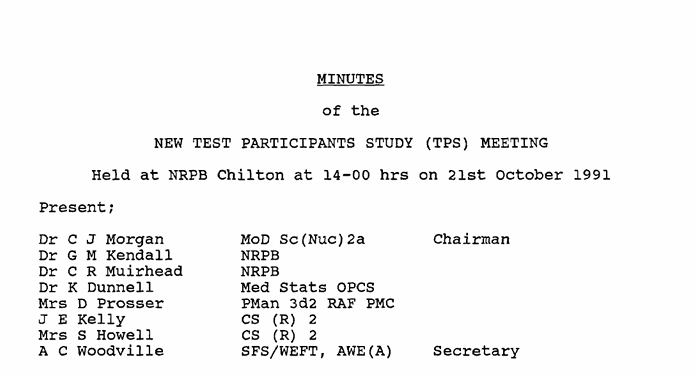
On the 21st October 1991, a meeting was held at NPRB Chilton. The first item was to discuss a letter from the Prime Minister to Terrence Higgins MP, pushing for the report to be published.

This committee, with no representative from affected communities, agreed that 100% tracing of all untraced test participants would not be possible. The committee would need, therefore, at some time to agree that diminishing returns necessitated termination of further searching should this be necessary.

Only 80% of the participants could be traced, and Dr Kendall stated that this is undesirably low and that there is always a suspicion that those not traced differ in some significant way from the majority. The study continued and was still published.

Servicemen are not covered by the HNS for their period of engagement, and this means that follow-up may be less reliable for other groups. It was a problem in the original study and will be a problem for this new study.
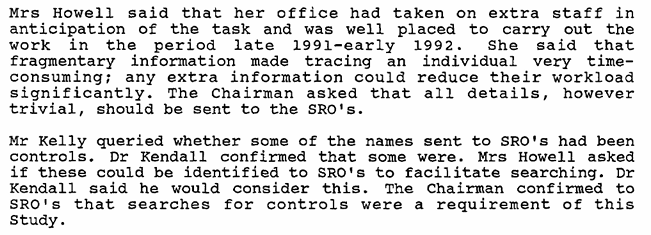
Why would Mr Kelly ask about controls? In order to keep this study without bias, the controls should be unknown to Mr Kelly, yet they asked for them to be identified.

Dr Kendall asked for 1000 participants missed from the original study to be traced. The names had been submitted after the original report. Again, the Chairman (MOD) steps in and says it would be desirable for the NPRB rather than the MOD to decide how much effort should be put into difficult searches. Not being very independent.

The Chairman pushes for a deadline, Dr Kendall stating that the work should be to a standard, not a deadline. Because Ministers were under pressure, they needed an early date. The Chairman then states that there is a political deadline, but he would rely on the advice of the NRPB. This report is about people, lives, not politics, yet the Chairman kept pushing.

Dr Kendall states that if the report did not complete the normal BMJ review, it would be valueless. Why is the Chairman asking about potential problems with the BMJ? We now know that the original conclusion was rewritten by the MOD, but why again is the Chairman asking such questions?
In December 1991, Dr Kendall met with representatives of the BNTVA. The report is from A C Woodville.

The first item was not any details about the report, just that Ken McGinley was not present and that the meeting was friendly and positive "because Ken McGinley was not there".

It is also stated that Dr Kendall believes that when McGinley learns of it, he will attempt to use it to embarrass the MoD. This is totally unacceptable reporting, creating division amongst campaigners.

It is reported that Dr Morgan is pressing hard for the report to be available in May, with concerns that problems may yet arise and that the final step, peer review, is not guaranteed.

Dr Kendall also had a meeting with the BAVA, which is described as a splinter of the BNTVA, less well organised and less aggressive in seeking publicity. Terrible language to use against veterans.
Mr Muirhead was also interested in following up on the excess of leukaemias amongst the servicemen aboard HMS Warrior. We believe that this was never completed.
A further meeting was held in February 1992, again chaired by Dr C J Morgan.


Dr Darby pointed out the seriousness of the potential bias of missing army records that had been sent unrecorded for a period in the 1960's. If only a few leukaemias existed amongst the missing records, this would be enough to affect the conclusions of the study.

Dr Kendall then blames the BNTVA for not replying sooner to self-responders for a delay of three months. Easy to blame a voluntary organisation for the delay.

Despite still receiving data at the rate of between one and ten per week, they instigated a cut-off period. What if those people had leukaemia? We understand the need for a cut-off, but these records should have continued to be processed, and if it was found that the bias was incorrect, an update should have been produced.
Was the report accurate?

Dr Kendall reports to the Chairman that the cancer registry was incorrect; that death certificates mention cancer, but the cancer registry doesn't. How can this data be relied upon?

Discussions over how primary and secondary cancers were being treated epidemiologically. How can the report be accurate when records were recording uncertain cases as 'site unknown'?
More Revelations

The DSS destroyed 750,000 files when the claim had been dormant for 30 years or more. If death was alleged to be due to service at trials that had arisen in the 1950's, these might have been destroyed. These are the men who died young, died early from their exposure, and their records have been destroyed, so they are not included in the study. Yet no mention of the destruction is in any of the NRPB reports.
Environmental monitoring

Dr Morgan put great importance on the dose assessments of the MOD. Wait, how can a report be independent when the Chair is stating that they have to use the MOD data and rely upon it?
Dr Kendall was concerned about potential doses from fallout. Dr Morgan refers him to the House of Commons Defence Committee report, which covered environmental monitoring, which we now know is incomplete and inaccurate after the 2014 whistle-blower report released this year.
Conclusion
As we have always stated, the MOD controlled the NRPB studies; they controlled the people who were included, chaired the meetings, used political pressure to influence the study, re-wrote the conclusions and pushed the scientists to use an incomplete, inaccurate environmental report.
The data was only 80% complete, the dosages are incomplete and supplied by the MOD, the cancer registry information is inaccurate, records of servicemen dying very early after the tests are not included, and 1,000 records were not followed up correctly.
The MOD blamed the BNTVA for the lateness of the report, slandered Ken McGinley, and accused a veterans organisation of being very disorganised.
We know that the excess leukaemia in HMS Warrior was never followed up. This report found that the leukaemia was just a chance finding, and the UK Government no longer paid out to the servicemen.
This shows the contempt the MOD had for the veterans organisations, the control of the study by the MOD and the political pressure applied to scientists trying to obtain the best data and the most accurate report.
A copy of these documents has been submitted to the Office for Veterans' Affairs and the Minister for Veterans and People for comment. We have been waiting for 19 months for a report on the independence of the NRPB study. I have been promised it soon. It is clear that the MOD had a massive influence on the report; in fact, they controlled it from start to finish, and Ken McGinley was right all along.


Comments