
Montebello Islands - Radioactive Signs
- Invisible Enemy

- Jan 9
- 3 min read

The Montebello Islands, where Britain tested nuclear weapons, still display a sign to this day stating that elevated radiation levels exist and that the visits must be restricted to 1 hour per day.
But why are the signs displayed?
It comes down to who is responsible for any harm caused if you suffer from any radiation-induced illness because of your stay on the island.
November 1952
The action to be taken when HMAS Hawkesbury departed the Islands and no longer patrolled the area was discussed in November 1952:
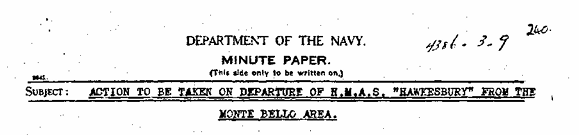

The document states that 'the Monte Bello area will still be very radioactive and to ensure no one is injured in any way or has cause to claim compensation from the Commonwealth as a result of exposure to radioactivity'.
The authorities knew that they had contained the area, knew that it was very radioactive, and that potentially they could be liable, so they decided to erect signs

The signs must be able to withstand a strong wind and be at least 10 ft by 8 ft.
Under the Act 19 of 1952 - Defence (Special Understanding) Act- it will be repealed on the 20th January 1953.

January 1953
Then the lawyers became involved. A document extracted from the newly released Merlin database provided a memorandum for the Secretary of State for Defence from the Attorney General's Department regarding repealing the Act, and the question of liability arose.

The question was asked if the Commonwealth would be liable for damages as a result of a person who suffers injury or illness as a result of entering those parts of the Islands which remain radioactive after the area ceases to be prohibited.

This statement alone is very disturbing; the area will no longer be a prohibited zone, but the authorities knew that it would remain radioactive and could cause health issues to anyone visiting the area.
Draft proclamations were drawn up and copies distributed.

The Attorney General's view is that the Commonwealth would only be liable in damages if it could be established that a person suffered injury or illness as a result of the breach of the Commonwealth's duty to take care in relation to that person or by some wrongful act or omission of the Commonwealth.

The Attorney General also states that he sees no ground on which injuries or illness were due to a wrongful act or omission after the area has ceased to be prohibited.
Yet would you not consider that the act of contaminating it in the first place was wrongful?
The reason given for this is that it was not the Commonwealth that carried out the test, but the United Kingdom Government.

Yet because of the circumstances, the Attorney General decided that they had to consider it just in case the Commonwealth became liable.
The Attorney General states that it is insufficient to show a general warning of danger; it is necessary to show that the person injured knew of the danger and was prepared to take the risk of injury.

However, if we continue to prohibit access to the area until the whole of the area ceases to be radioactive, entry into the area, except in pursuance of a permit and would be unlawful and liability would not arise.

The recommendation is to continue to keep the area a prohibited area until the area ceases to be radioactive.

Yet the islands are still radioactive, the signs were erected, and the decision was made not to prohibit access.
Conclusion
When the UK tested weapons in the Montebello Islands, they left behind a very radioactive area. They knew about the potential damage that could be caused by visiting the area, and they knew that they should keep it a prohibited area.
Yet this did not fit the narrative that the testing program was safe, that there was no danger. So instead, they erected signs so that their liability was reduced. 'Enter at your own risk.'
In 2025, Paul Grace returned to the Montebello Islands, and their Geiger Counter registered high levels of radioactivity. Read about it (https://www.labrats.international/post/montebello-expedition-diary-part-i-by-paul-grace)
So a decision made in November 1952, challenged in January 1953, still has consequences today. If you ever visit the islands, beware, the radiation levels are still extremely dangerous, and you do so at your own risk. The only catch, you have to read English to understand that. If you cannot, then the sign is useless, but at least the Commonwealth isn't liable for any damages.


Comments